How to Check AFT Lucknow Case Status & Cause List Online
Armed Forces Tribunal (AFT) Lucknow Case Status: Step-by-Step
A practical guide for veterans, serving personnel and family pensioners in Uttar Pradesh and Uttarakhand on tracking AFT Lucknow Bench cases, daily orders and cause lists online.
If you are a veteran, a serving soldier, or a family pensioner living in Uttar Pradesh or Uttarakhand, your military service disputes are heard by the Armed Forces Tribunal (AFT) Lucknow Regional Bench — and its records are kept on a separate government server from the ordinary civil eCourts system.
Every day, hundreds of defence personnel struggle to track their pending disability pension cases, discharge orders, or promotion disputes. They look for their case on the standard civil eCourts app and find absolutely nothing. The core fact is that the Armed Forces Tribunal is an independent judicial body. Its digital records, daily orders, and cause lists are kept on a separate government server. To find your exact hearing date and case status, you must use the official, centralized portal at the aft.gov.in website and specifically choose the Lucknow Regional Bench. This guide explains exactly how to navigate that system.
How the AFT Lucknow Tracking System Works
Historically, military personnel had to rely entirely on their advocates or physically visit the AFT Lucknow premises located near Somnath Dwar in the Lucknow Cantonment to get case updates. Today, the Ministry of Defence operates a central digital portal. When a petition is filed in Lucknow, it is first given a Diary Number. Once the registry accepts the documents and verifies that they are in order, the matter receives a formal Case Number. The progress of this case — including the next hearing date, the courtroom number, and the daily orders passed by the judges — is uploaded exclusively to the AFT's own central database.
What Is the Main Issue for Most Users?
In simple terms, the main problem is that users look for their military cases in the wrong place. The Indian judicial system separates ordinary civil courts from specialized tribunals. District Courts and High Courts use the regular eCourts portal and the National Judicial Data Grid (NJDG). However, AFT cases are completely excluded from the eCourts network. If you type your AFT case number into the eCourts app, it will tell you the case does not exist.
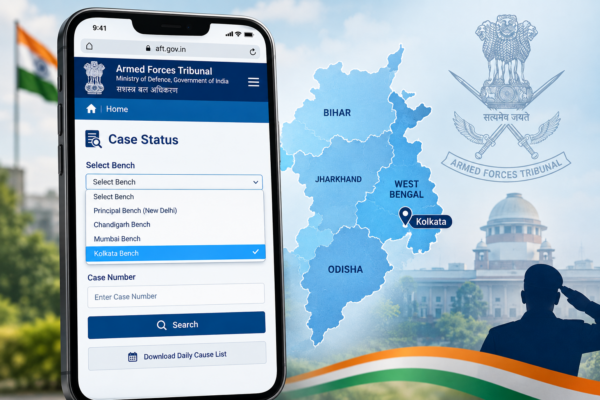
Furthermore, many users visit the central AFT portal but forget that it houses records for eleven different benches across India. If you do not manually choose "Lucknow Bench" from the drop-down menu, the system will query the Principal Bench (Delhi) records by default and fail to find your Uttar Pradesh or Uttarakhand case.
Jurisdiction: Who Falls Under the AFT Lucknow Regional Bench?
The Armed Forces Tribunal has one Principal Bench in New Delhi and ten Regional Benches across India. The Lucknow Regional Bench has strict territorial jurisdiction. According to official notifications, it currently hears matters for military personnel, veterans, and widows residing in:
State
Uttar Pradesh
State
Uttarakhand
Bench Type
Regional Bench
Portal
aft.gov.in
Note: Previously, the states of Madhya Pradesh and Chhattisgarh also fell under the Lucknow Bench. However, those states are now covered by the newer Jabalpur Regional Bench. If your case is very old, it may have originated in Lucknow before being transferred.
Step-by-Step Guide: How to Check AFT Lucknow Case Status
To find your exact hearing date or read the daily orders, you must follow these official steps exactly as they appear on the government website.
Step 1 · Visit the Official Central Portal
Open your web browser and go directly to aft.gov.in/case-status. Do not rely on older, outdated regional NIC websites, as the central portal is now the primary source for all benches.
Step 2 · Choose the Correct Bench
By default, the portal may show the Principal Bench. You must click the drop-down menu labeled "Choose Bench" and pick Lucknow Bench. If you skip this step, your lookup will fail.
Step 3 · Choose Your Correct Method
- Find by Case Number: Choose the Case Type (for example, OA or MA), enter the Case Number, and pick the Year the case was filed.
- Find by Diary Number: Use this tab if your matter is very new and has not yet received a formal case number.
- Find by Party Name: Enter your name (the Petitioner) or the government department you are suing (the Respondent). For military cases, look up using your rank, name, and service number exactly as written in your legal documents to avoid name mismatches.
Step 4 · Enter the Captcha and Submit
Type the security letters shown on the screen and click "Submit." Your case details will appear, showing the next date of hearing, the courtroom number, and the status of the matter.
Important Note
The website only shows the status of the case. A status showing "Disposed Of" does not mean you have won or lost until you read the final written judgment uploaded to the portal.
How to Download the Daily Cause List and Daily Orders
A "Cause List" is simply the official timetable of the court for a specific day. It tells you which judge is sitting, which cases will be heard, and in what order. To check if your case is listed for tomorrow:
- Go to the main website at aft.gov.in.
- Click on the Cause List section in the main menu.
- Pick Lucknow Bench from the options and choose the date.
- A PDF document will download. You can open this PDF on your mobile phone and scroll through it to find your name or case number.
A "Daily Order" is the short written instruction given by the judge at the end of a hearing. You can also download these from the case status portal to see exactly what happened in the courtroom on your hearing date.
Important Legal Terms Explained
When you check your AFT Lucknow case status, you will see legal abbreviations that may be confusing. Here is what they mean in simple English:
The person who filed the case — usually the veteran, the serving soldier, or the family pensioner.
The authority defending the case — almost always the Union of India, the Ministry of Defence, or the specific service headquarters.
The main lawsuit — a fresh case claiming disability pension, challenging a court-martial, or fighting a promotion denial.
An application filed inside an already existing case, such as a request to submit a document late.
Cases transferred from a High Court (like the Allahabad High Court) to the AFT after it was created in 2007.
The tribunal has finished hearing the case and given its final judgment — the case is officially closed.
The case is still running and waiting for a final decision.
The back-payment of pension or salary owed for previous months or years.
What Does This Digital System Mean for Readers?
For ordinary readers, veterans, and military families in Uttar Pradesh and Uttarakhand, understanding this digital system means empowerment. Relying entirely on an advocate to provide updates can sometimes cause delays and miscommunication. By knowing how to navigate the official central portal, a retired soldier in a rural village can independently verify exactly what is happening in their case — including whether the Ministry of Defence has filed its reply (called an affidavit) or if the hearing has simply been delayed to a new date.
Important Points to Remember
AFT cases do not appear on the regular civil eCourts website.
The correct website for all AFT cases across India is aft.gov.in.
You must actively choose "Lucknow" from the bench drop-down menu, or the lookup will fail.
The Lucknow Bench covers Uttar Pradesh and Uttarakhand.
The most accurate way to look up is by your OA number and the year of filing.
Cause lists (the daily timetable) are published as PDF files for each specific bench.
Related Government Rules and Structure
The Armed Forces Tribunal was established under the Armed Forces Tribunal Act, 2007. According to this Act, the tribunal has the exclusive power to adjudicate disputes regarding commission, appointments, enrollments, and conditions of service. It also handles appeals arising from court-martial verdicts.
Every AFT bench, including Lucknow, consists of a Judicial Member (a retired High Court judge) and an Administrative Member (a retired senior military officer, usually of Major General rank or equivalent). This ensures that the court understands both the complex civil law and the specific military rules governing the Indian Armed Forces.
Conclusion
Navigating the Armed Forces Tribunal portal can feel confusing at first, but it is a highly structured system once you know the rules. By understanding that AFT records are separate from the civil eCourts system, and by knowing exactly how to choose the Lucknow Regional Bench, veterans in UP and Uttarakhand can track their service matters with confidence and clarity.