8th Pay Commission Delay: How It Impacts Your Arrears and Upcoming DA Hike
8th Pay Commission Delay: How It Impacts Your Arrears and Upcoming DA Hike
Over one crore central government employees and pensioners are watching two developments this festive season: the expected DA hike announcement before Dussehra, and concerns over delays in the 8th Pay Commission.
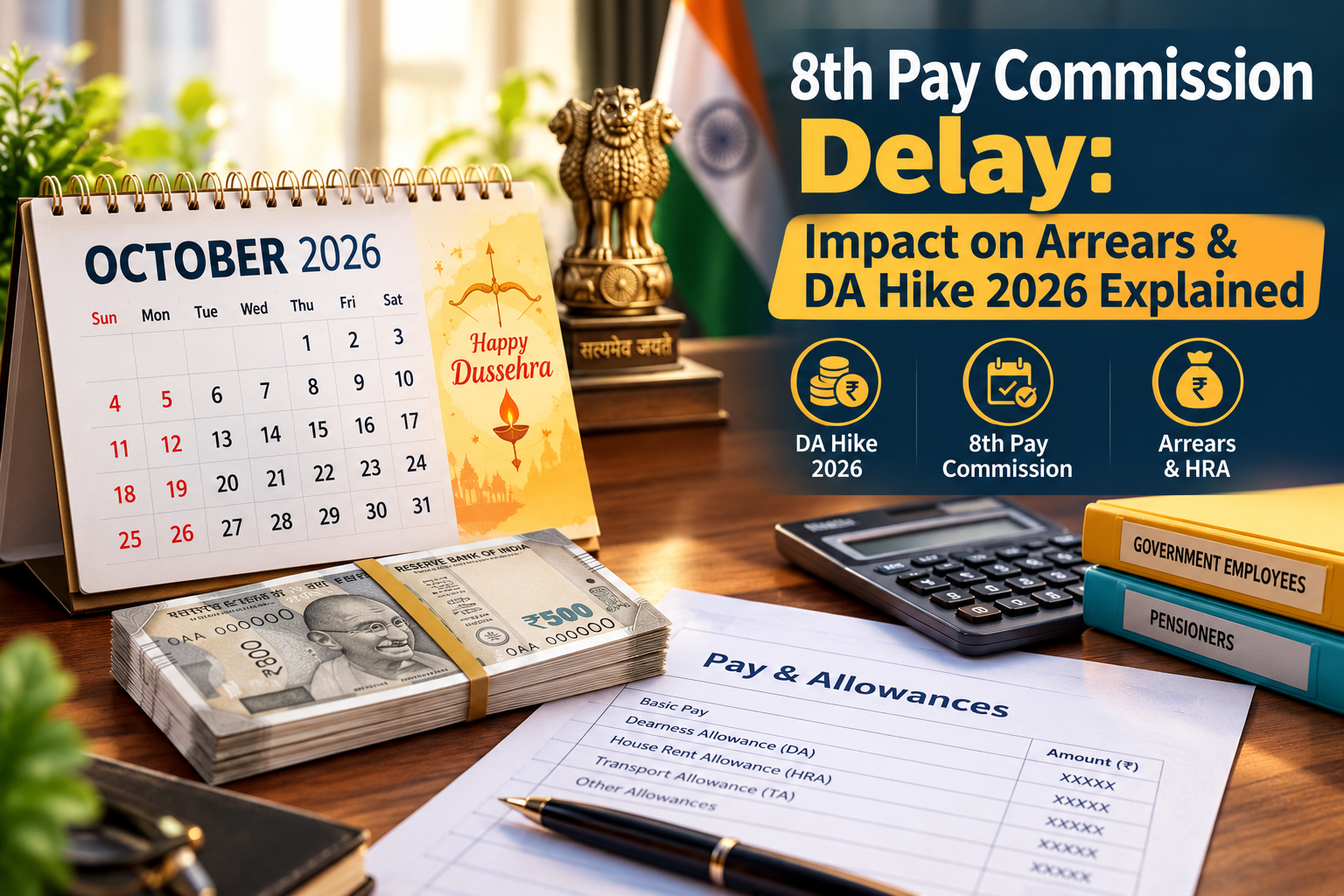
Over one crore central government employees and pensioners across India are closely monitoring two major financial developments this festive season: the expected announcement of the Dearness Allowance (DA) hike before Dussehra, and growing concerns over delays in the implementation of the 8th Pay Commission.
While the pending DA hike offers short-term relief, questions regarding the timeline of the 8th Pay Commission have sparked debate over employee arrears, revised allowances, and potential long-term financial impacts.
What Happened?
Central government employees are waiting for the Union Cabinet to formally approve the latest Dearness Allowance revision, which takes effect retrospectively from July 1, 2026. At the same time, discussions around the 8th Pay Commission have intensified across news platforms and search engines. Because central pay commissions typically follow a 10-year cycle, the recommendations of the 8th Pay Commission are broadly expected to take effect from January 1, 2026. However, formal notifications regarding its formation and terms of reference remain pending.
- 1 Jan 2026Broadly expected effective date for 8th CPC
- 1 Jul 2026DA revision effective date
- Early Oct 2026No formal Cabinet announcement yet
- UpcomingCabinet review expected ahead of festive holidays
Why Is It Trending?
Simultaneously, financial reports analyzing potential delays in the pay commission rollout have heightened curiosity among current staff and retirees, who want to know how delayed implementation could affect their take-home salaries and accumulated arrears.
What Do These Terms Mean?
To understand the financial implications, it helps to break down common administrative terms into simple language:
Dearness Allowance (DA)
A cost-of-living adjustment paid by the government to employees and pensioners to offset the impact of inflation. It is revised twice a year based on consumer price data.
Central Pay Commission (CPC)
A government-appointed body set up approximately every decade to review and recommend changes to salary structures, allowances, and pensions for central employees.
Arrears
Money that is owed to an employee from a past date. For example, if a pay revision scheduled for January is approved months later, the difference for those past months is paid as arrears.
House Rent Allowance (HRA)
An allowance provided to employees to cover rented accommodation expenses, calculated as a percentage of basic salary.
The Impact on Arrears and HRA
Media reports have focused on what happens if administrative procedures push back the rollout of the 8th Pay Commission.
According to a report by Aaj Tak, procedural delays in establishing the commission could affect allowances such as HRA. When a pay commission updates the basic pay matrix, allowances tied to basic pay also increase. Media calculations suggest that if revised pay structures and allowances take longer to finalize, employees could face transitional losses or delays of up to ₹3 lakh in aggregate benefits depending on their pay grade.
Live Hindustan reports that a major question among employee unions is the benchmark date for calculating arrears. Historically, even when pay commission recommendations were accepted after delays, revisions were applied retrospectively from the target effective date (such as January 1). However, until the government clarifies the terms of reference, whether all revised components will be covered retrospectively remains an open question.
What Has the Government Said?
As of early October 2026, the Union Cabinet has not made a formal announcement regarding the exact percentage of the July 2026 DA hike, nor has the Ministry of Finance released an official roadmap for the 8th Pay Commission. Official approval for the DA hike typically comes directly through a Cabinet briefing, followed by a formal notification from the Department of Expenditure.
What Happens Next?
- Cabinet Review: The Union Cabinet is expected to review the pending DA hike recommendation in an upcoming meeting ahead of major festive holidays.
- Notification of Pay Commission: Employee associations continue to submit representations requesting the timely constitution of the 8th Pay Commission. Any formal progress will begin with the publication of the commission's terms of reference in the official gazette.
Key Takeaways
- DA Hike Awaited: The July 2026 DA hike for central government employees and pensioners awaits official Union Cabinet approval, with an announcement widely expected around the festive season.
- 8th CPC Timeline: While the 10-year cycle points to a January 1, 2026 baseline, the commission's formal structure has not yet been notified.
- Arrear Queries: Employees are seeking clarity on whether pay hikes and allowance revisions will be calculated retrospectively from the beginning of 2026.
- Official Confirmation Pending: Calculations of potential financial impacts remain media estimates until official notifications are issued by the Ministry of Finance.
Sources & References
-
Aaj Tak
8वां वेतन आयोग लागू होने में हुई देरी... तो होगा 3 लाख का नुकसानDetailed reporting on estimated calculations regarding HRA and salary impacts due to potential pay commission delays.
-
Live Hindustan
8th Pay Commission Updates: When Central Govt Employees Will Get Revised SalaryCoverage on employee questions regarding arrear calculations from January 1, 2026.
-
Ministry of Finance / Department of Expenditure, Government of India
Official notificationsReference authority for official notifications on Dearness Allowance revisions and Pay Commission terms of reference.