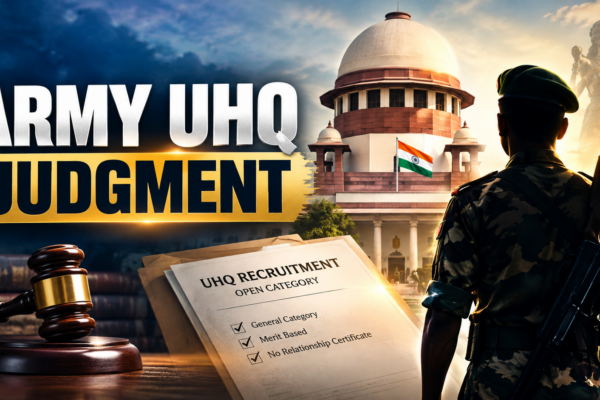
Understanding the Recent Supreme Court Judgment on Disability Pension: A Comprehensive Overview
Introduction
In a recent landmark judgment, the Supreme Court of India addressed the issue of disability pension entitlement for armed forces personnel. The case, titled Commander Rakesh Pande v. Union of India & Ors., dealt with the assessment of disability and its attribution to military service.
Background
Commander Rakesh Pande, an officer in the Executive Branch of the Indian Navy, took premature retirement in 2001 after serving for 20 years. During his tenure, he was diagnosed with Non-Insulin Dependent Diabetes Mellitus (NIDDM) and Hyperlipidaemia. Despite these medical conditions, he was denied disability pension on the grounds that his disabilities were not attributed to or aggravated by his military service.
The Legal Battle
Commander Pande contested this decision, leading to a series of legal proceedings. The Release Medical Board (RMB) initially assessed his disabilities at 20% for NIDDM and 6-10% for Hyperlipidaemia for a period of 5 years. However, the denial of disability pension remained.
He approached the Armed Forces Tribunal, which ruled in his favor, granting him disability pension at 20% for 5 years, extended to 50% based on the precedent set by the Union of India & Ors. vs. Ram Avtar (Civil Appeal No.418 of 2012).
The Key Argument
The crux of the matter hinged on the interpretation of a government letter dated 07.02.2001, which outlined the modalities for implementing the recommendations of the 5th Central Pay Commission. This letter stated that disabilities assessed by the Medical Board would be considered for life, except in cases of non-permanent disabilities, unless an individual requested a review.
Supreme Court’s Ruling
The Supreme Court, in its judgment, emphasized that periodic reviews for reassessment of disabilities should not be conducted for disabilities deemed permanent. Since Commander Pande’s conditions were of a permanent nature, the Court held that he was entitled to disability pension for life, not limited to a mere 5-year period.
Conclusion
This ruling sets a significant precedent in cases of disability pension entitlement for armed forces personnel. It establishes that disabilities classified as permanent are eligible for lifelong disability pensions, reinforcing the principle of upholding the rights and well-being of military personnel who have dedicated their lives to service.
(Disclaimer: This blog post is a summary and analysis of the judgment. For specific legal advice, consult a qualified attorney.)
To download judgment copy [click here]